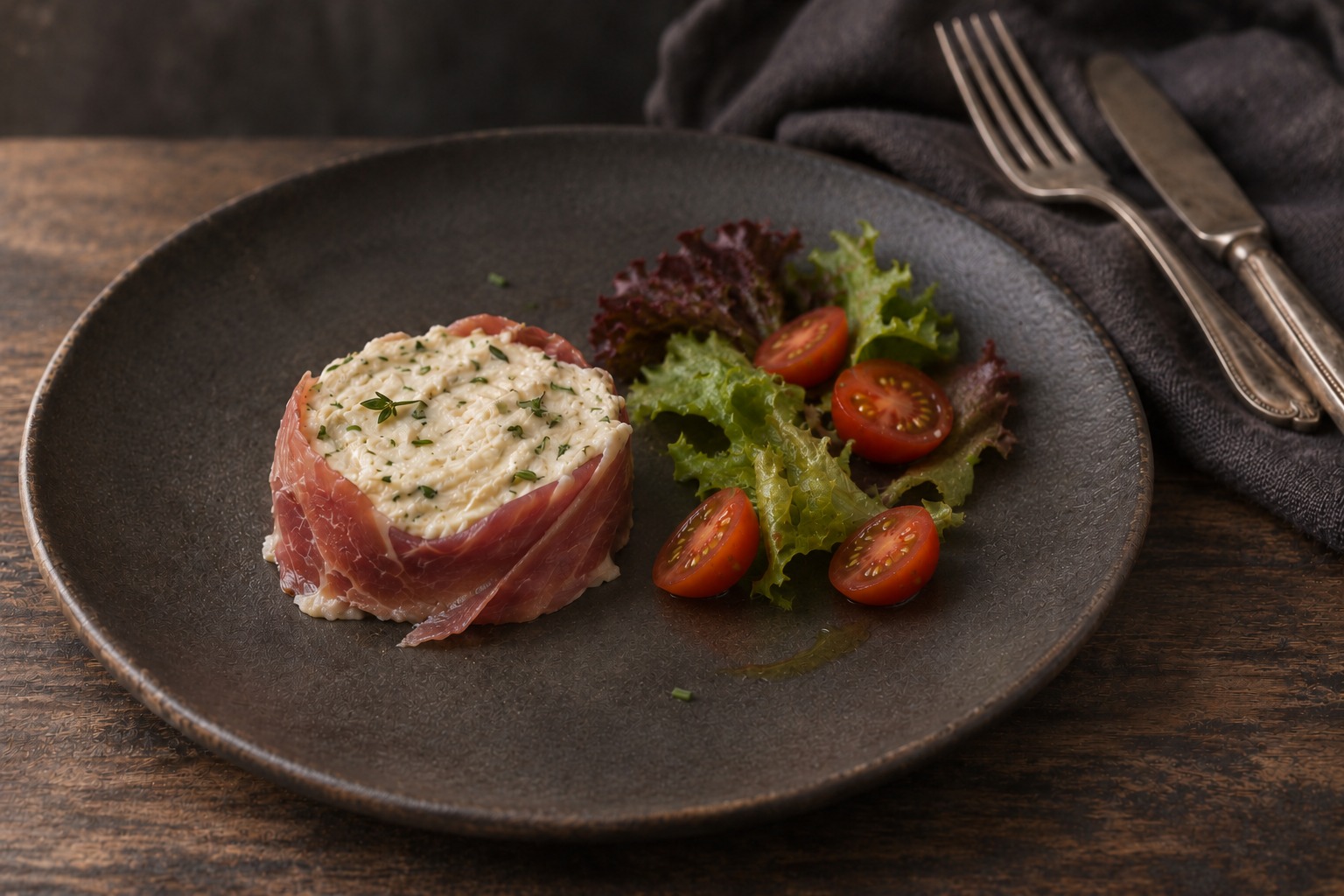
Cold ricotta and herb soufflé with cured ham
6
servings25
minutes5
minutes240
kcal4
hours4
hours30
minutesA savoury ricotta, cream and fresh herb mousse, lightened with whipped egg whites and set in the fridge. Thin cured ham surrounds each portion, with salad leaves and cherry tomatoes alongside. A starter from Bernie Torras's recipe collection to prepare ahead, accompanied by Puchero MIX's Italian Kitchen Serenade.
Keep your device screen on while you cook
Ingredients
- For the mousse
200 g ricotta made from pasteurised milk, drained if there is loose whey
120 g pasteurised egg whites suitable for whipping and uncooked use, equivalent to about 4 whites
6 g unflavoured pork gelatine leaves, approximately three 2 g leaves; check the packet
150 ml single cooking cream with 18% fat
10 g fresh herbs with tough stems removed: 4 g parsley, 4 g chives, 1.5 g thyme and 0.5 g rosemary
- Ham and salad
4 large thin slices of dry-cured ham, about 80 g in total
120 g mixed lettuce leaves, washed and dried
180 g cherry tomatoes, washed
- Oil and seasoning for both preparations
60 ml olive oil for the whole recipe, equivalent to four 15 ml tablespoons
Salt, only if needed
A pinch of ground black pepper
Method
- Prepare six individual moulds of about 120–150 ml. Measure the 60 ml oil: reserve 30 ml for the filling, 5 ml for the moulds and 25 ml for the salad. Lightly brush the moulds with oil and cut the four ham slices into wide strips. Divide them between all six moulds, overlapping the strips to line the sides. If using rings, place them on a flat tray and line the inside with food-grade acetate.
- Soak the gelatine leaves separately in plenty of cold water for about 5 minutes, or as directed on the packet. Finely chop the parsley, thyme and rosemary leaves and the chives. Drain the ricotta only if it has separated whey.
- Gently heat the cream in a small pan for about 3–5 minutes until hot and steaming, without boiling. Remove from the heat. Squeeze out the soaked gelatine and stir it into the cream until completely dissolved. Allow it to lose its intense heat: it should be lukewarm and still liquid.
- Beat the ricotta with the 30 ml oil and the herbs until evenly combined. Mix two spoonfuls of this mixture into the lukewarm cream first, then stir everything back into the bowl. Add pepper and taste before adding salt, as the ham already provides plenty. Do not let the mixture start to set before adding the whites.
- In a separate clean, dry, grease-free bowl, whip the pasteurised whites to firm but flexible peaks. Use a product whose manufacturer specifies that it is suitable for whipping and uncooked preparations. Stir one-third into the ricotta mixture to lighten it, then gently fold in the rest with a spatula.
- Immediately divide the mousse between the six moulds without pressing it down. Gently level the tops, cover and refrigerate at 4°C or below for at least 4 hours, until firmly set. If it is still too wobbly to unmould, allow more chilling time.
- Just before serving, halve the cherry tomatoes and toss them with the lettuce leaves and the reserved 25 ml oil. Carefully unmould the mousses; lift off the rings and peel away the acetate if used. For closed moulds, gently loosen the edge and turn onto plates without warming the mousse.
- Serve one cold soufflé per person with one-sixth of the salad: about 20 g leaves and 30 g cherry tomatoes. Keep the portions refrigerated until serving. The texture should be soft and airy, with the ham sitting naturally around the sides.
Notes
- Cream cheese or mascarpone can replace the ricotta for a denser, creamier result. Drain any loose whey from ricotta to prevent the soufflé from weeping.
- Check the weight and instructions for your gelatine sheets; sizes vary. Agar is not a direct swap and needs a different quantity and method.
- Use pasteurised egg whites suitable for whipping and uncooked dishes. Fold them into the lukewarm cream gently to retain the air.
- Chill for at least four hours and unmould only when firm. Keep refrigerated until serving and dress the salad at the last moment.
Equipment
- Six individual 120–150 ml moulds or small rings with food-grade acetate
- Two bowls, electric whisk and flexible spatula
- Small saucepan, pastry brush and measuring jug
- Scales, knife, board and a tray that fits in the fridge
Estimated nutrition per serving
- Calories: 240kcal
- Fat: 19.6g
- Saturated Fat: 7.7g
- Sodium: 348mg
- Carbohydrates: 4.5g
- Fiber: 0.7g
- Sugar: 2.1g
- Protein: 11.9g
Have you made this recipe? I want to see it!
Tag @pucheromix on Instagram with the hashtag #mipuchero