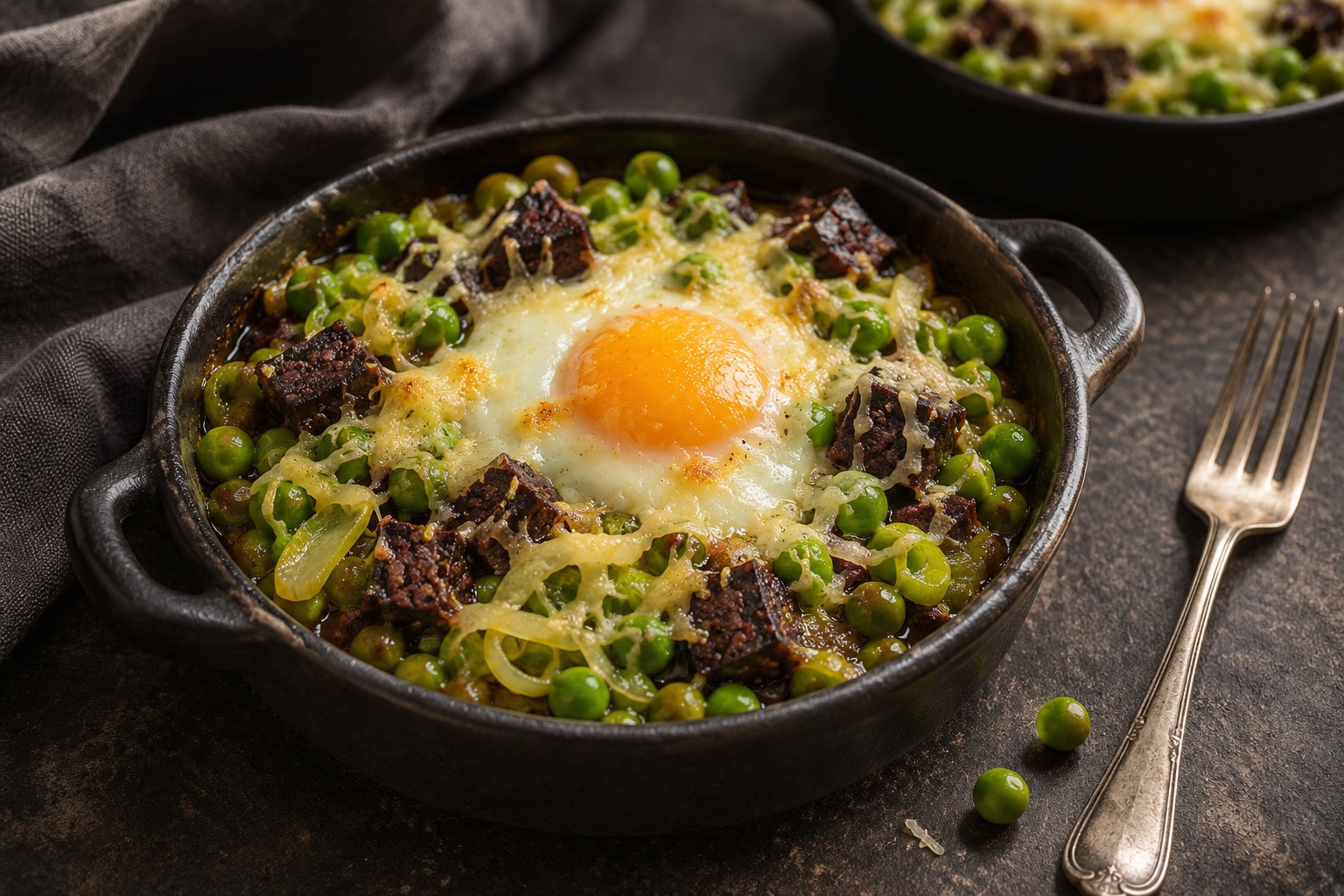
Baked eggs with peas and black botifarra
4
servings15
minutes45
minutes520
kcal/serving1
hourIndividual dishes of peas and softened spring onions with Catalan black botifarra, a splash of sweet Muscat wine and an oven-baked egg beneath melted cheese. A simple, savoury recipe by Bernie Torras for four.
Mantén encendida la pantalla de tu dispositivo mientras cocinas
Ingredients
4 eggs, approximately 50 g edible weight each
400 g fresh shelled peas (weight without pods)
200 g cooked Catalan black botifarra blood sausage, casing removed
300 g trimmed spring onions, white and tender green parts, finely chopped
50 ml sweet Muscat wine or mistela
50 g grated Emmental cheese
30 ml olive oil (suggested quantity for the original drizzle)
Salt and black pepper to taste
Hot water, only as needed to keep the peas from drying out
Method
- Trim and finely chop the spring onions. Remove the casing from the cooked black botifarra and cut into 1–1.5 cm cubes. Weigh the shelled peas and grate the cheese.
- Warm the 30 ml olive oil in a saucepan over low heat. Add the spring onions and cook, covered, for 10 minutes, stirring occasionally. Uncover and cook for another 5 minutes until tender without browning heavily.
- Add the peas and 50 ml sweet Muscat wine. Stir, bring to a simmer and cook gently for about 15 minutes for fresh peas. Partly cover and add one or two tablespoons of hot water at a time if the mixture dries out; the peas should be tender and moist, without a pool of liquid.
- While the peas cook, preheat the oven to 200 °C conventional heat, without the fan. Place a tray on a lower-middle shelf and prepare four shallow individual ovenproof dishes.
- Taste the peas and season lightly, allowing for the salt in the sausage and cheese. Divide the still-hot base between the four dishes and scatter over the cubes of botifarra.
- Make a small hollow in the centre of each dish. Crack each egg into a clean cup first, then slide it into its hollow, one per person. Divide the 50 g cheese between the dishes, mainly around the egg.
- Bake at 200 °C and begin checking after 8 minutes. Allow approximately 10–15 minutes, or longer if needed: both white and yolk should be set and the centre of the dish should reach 74 °C. If the cheese browns first, loosely cover with foil and continue cooking.
- Remove using oven gloves and serve immediately, one dish per person. Pair with a light starter and a refreshing dessert; the quantities in this recipe cover only the four baked egg dishes.
Notes
- The handwritten notes specify four servings: one egg, 100 g peas and 50 g botifarra per person. The method includes the noted 10 minutes covered and 5 uncovered for the onions, and approximately 15 minutes for fresh peas.
- Use cooked Catalan black botifarra, a blood sausage. The title and ingredient list specify the black variety; do not automatically replace it with pale botifarra del perol. The 30 ml oil and Emmental make the unspecified drizzle and grated cheese reproducible.
- The printed 3–4 minutes in the oven do not ensure a cooked egg. Timing depends on the oven, dish depth and temperature of the base: follow the doneness checks in the baking step. Allow an estimated 15 minutes preparation and 45 minutes cooking, 60 total, with fresh peas.
- For frozen peas, follow the pack and check earlier, usually after 5–8 minutes; total time will be shorter. The handwritten alternative replaces the 50 ml sweet Muscat with white wine for a less sweet result. Cooking wine does not guarantee that all alcohol evaporates.
- Estimated nutrition per quarter of the recipe uses 50 g edible egg per egg, all 30 ml oil, Swiss-style cheese as an Emmental reference and generic USDA sweet dessert wine. The black botifarra reference is Embotits de Planoles; brands vary substantially. All wine energy is counted without subtracting evaporation. Total carbohydrate includes fibre.
- Estimated sodium corresponds to about 1.13 g salt per serving before seasoning. Drinks and other menu dishes are excluded; final cooked serving weight has not been measured. Allergens: egg, milk and sulphites from the wine; also check the sausage label.
Equipment
- Lidded saucepan
- Knife and chopping board
- Scales, measuring jug and grater
- Four shallow ovenproof dishes and a baking tray
- Cup for cracking the eggs
- Food thermometer and oven gloves
Estimated nutrition per serving
- Calories: 520kcal
- Fat: 35.0g
- Saturated Fat: 13.9g
- Sodium: 453mg
- Carbohydrates: 22.2g
- Fiber: 7.7g
- Sugar: 8.6g
- Protein: 24.0g
Have you made this recipe? I want to see it!
Tag @pucheromix on Instagram with the hashtag #mipuchero