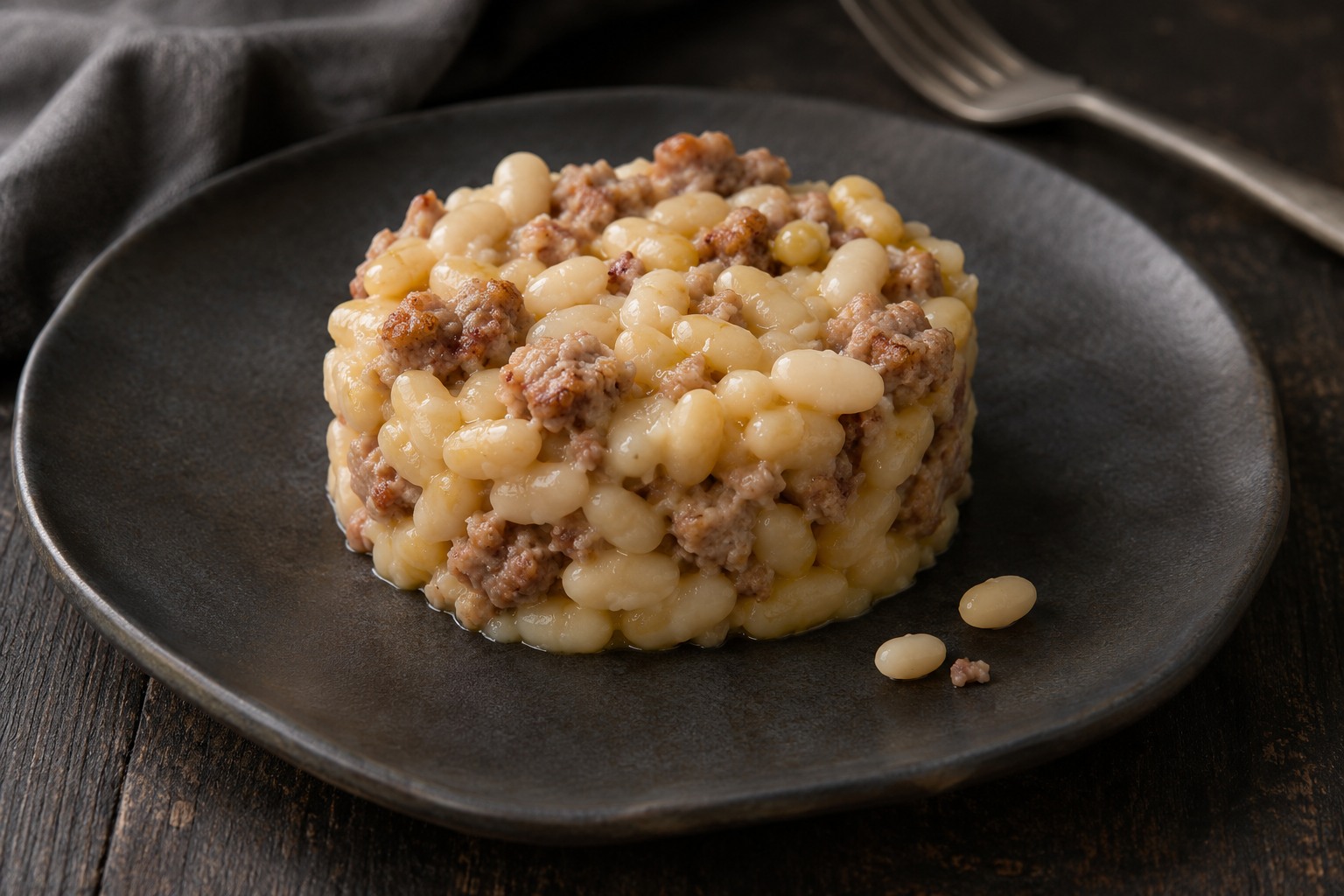
Santa Pau beans with botifarra del perol
Course: Main courseCuisine: CatalanDifficulty: Easy
Servings
6
servingsPreparation (approx.)
5
minutesCooking (approx.)
12
minutesCalories (approx.)
420
kcal/servingTotal time (approx.)
17
minutesTender Santa Pau beans, crumbled botifarra del perol and a little olive oil. Three ingredients make a Catalan dish that comes together in a frying pan and can be served as small timbales. Start with beans that are already cooked.
Modo cocción
Mantén encendida la pantalla de tu dispositivo mientras cocinas
Ingredients
800 g Santa Pau beans, already cooked and thoroughly drained
400 g cooked botifarra del perol pork sausage, casing removed
15 g olive oil, suggested amount for the pan
Method
- Drain the cooked beans gently and weigh out 800 g. They should be tender but still hold their shape. Drain jarred or canned beans thoroughly; the timing for this recipe starts with cooked beans, not dried beans.
- Remove the casing from the botifarra del perol and weigh out 400 g of the edible sausage. Cut it into pieces to make it easier to crumble. Use botifarra del perol that is already cooked.
- Heat the olive oil in a wide frying pan over medium-low heat. Add the sausage and warm it gently, breaking it into small pieces with a spatula, for about 5–6 minutes. Do not let it burn.
- Add the beans and cook together for 5–6 minutes, until thoroughly hot. Fold gently with the spatula or shake the pan carefully so the beans do not break up too much.
- Divide into six portions. To follow the original presentation, place a cooking ring on a plate, fill it without crushing the beans, then lift it off carefully. You can also serve straight from the pan.
- Serve immediately. The sausage already contains salt: taste before considering any extra. The base recipe and its nutrition calculation contain no added salt.
Notes
- Yield: six servings, each one sixth of the recipe. The final cooked weight has not been measured.
- The 800 g refers to cooked, drained beans. The scan does not explicitly say ‘cooked’, but its final 5–6-minute sauté assumes that they are already tender. This clarification is consistent with the preparation published by the Fesols de Santa Pau PDO.
- The source lists olive oil without a quantity. The 15 g is a practical suggestion for the whole pan and the assumption used for nutrition; adjust only as needed for your pan and the fat released by the sausage. The base recipe contains no added garlic, onion or garnish.
- Estimated time: 5 minutes preparation and 12 minutes cooking, about 17 minutes in total. Soaking and cooking dried beans are not included. Use cooked botifarra del perol; raw fresh sausage requires a different preparation.
- Estimated nutrition per serving: about 420 kcal. Calculated with 800 g unsalted cooked white beans from USDA SR28 as a proxy for Santa Pau beans, 400 g botifarra del perol using the N. Vicens label, and 15 g olive oil, counting all the fat in the pan. Sausage brands can change the values substantially.
- Total carbohydrate includes fibre. Estimated sodium is 488 mg per serving, equivalent to about 1.22 g salt, with no extra salt added. Salted canned beans may increase this. The menu and drinks are excluded; cholesterol is not reported because sufficient data is unavailable.
- Allergens: plain beans and olive oil do not themselves contain the allergens that require declaration. Always check the sausage ingredients and trace warnings, which vary by manufacturer. This recipe is not an allergen-free guarantee.
- Our cooking soundtrack is Puchero MIX Cat from our Spotify profile, featuring Sopa de Cabra, Manel, Els Pets and other artists to accompany the dish’s Catalan character.
- The image is an AI-generated illustration of the dish.
Equipment
- Wide frying pan
- Spatula
- Colander and kitchen scales
- Knife and chopping board
- Cooking ring, optional
Estimated nutrition per serving
- Calories: 420kcal
- Fat: 20.3g
- Saturated Fat: 6.1g
- Sodium: 488mg
- Carbohydrates: 33.5g
- Fiber: 8.4g
- Sugar: 0.5g
- Protein: 27.0g
Have you made this recipe? I want to see it!
Tag @pucheromix on Instagram with the hashtag #mipuchero