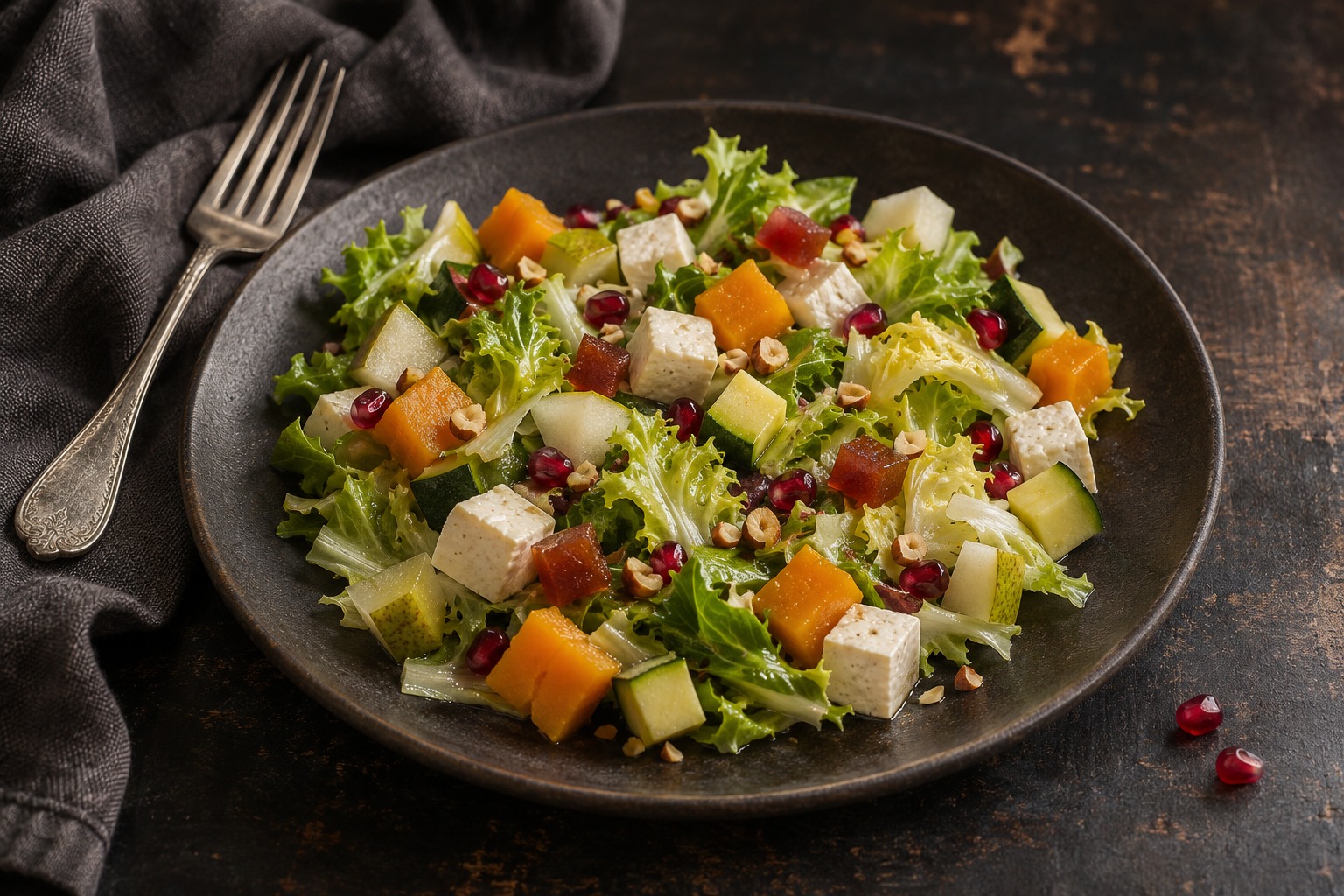
Pumpkin salad with quince paste
6
servings20
minutes10
minutes390
kcal/serving10
minutes40
minutesCrisp escarole, pumpkin, pear and pomegranate with diced tofu and quince paste, dressed with homemade hazelnut oil. Bernie Torras's salad serves six as a starter and follows the corrected quantities in his notes.
Mantén encendida la pantalla de tu dispositivo mientras cocinas
Ingredients
1 head of escarole, washed and thoroughly dried
1 small courgette
200 g pumpkin flesh, peeled and deseeded
2 pears
1 pomegranate
100 g plain firm tofu suitable for cold consumption according to the pack
100 g quince paste (membrillo)
50 g unsalted toasted hazelnuts (40 g for the dressing and 10 g to finish)
150 ml mild olive oil for the homemade hazelnut oil
2 tablespoons water for microwave cooking (about 30 ml)
Flaky salt to taste
Method
- Wash, drain and thoroughly dry the escarole. Chop into small pieces and set aside in a large bowl.
- Cut the pumpkin and courgette into roughly 1 cm cubes. Put the pumpkin in a microwave-safe dish with the two tablespoons of water and cover with a vented lid. Start with 3 minutes at 800 W. Add the courgette, stir and cook for another 2–3 minutes. Check and continue in 1-minute intervals if needed: both should be tender but firm, not falling apart.
- Briefly cool the vegetables under cold water, as the scan directs, and drain thoroughly. Allow about 10 minutes to lose their heat, then dry any excess moisture before adding to the leaves.
- Reserve 10 g hazelnuts and chop them for the finish. Blend the other 40 g with the 150 ml mild olive oil and pass through a fine sieve. This makes the homemade hazelnut oil for the dressing.
- Drain and dice the tofu. Use a product whose pack allows cold consumption, or cook as instructed and cool first. Dice the quince paste into small pieces. Open the pomegranate and remove the arils, discarding the white membranes.
- Wash and core the pears, then dice just before assembling to limit browning. Leave the skins on if sound and well washed.
- Gently combine the escarole, cooled vegetables, pear, pomegranate, tofu and quince paste. Add flaky salt sparingly and distribute the hazelnut oil throughout the salad.
- Divide among six starter plates and scatter over the reserved 10 g hazelnuts. Dress just before eating to keep the escarole crisp. If preparing ahead, store the components separately in the refrigerator and follow the tofu pack instructions.
Notes
- Source: F0207-1, 'Amanida de carabassa amb codonyat', serving six. The handwritten corrections are applied: 50 g hazelnuts and 150 ml oil, replacing the printed 150 g and 200 ml. The tip to cut the pear at the last moment is also used.
- The printed method blends 50 g hazelnuts and garnishes with the remainder. With the corrected total now 50 g, this version allocates 40 g to the dressing and 10 g to the finish. That allocation is an explicit adaptation; no extra nuts are added. Mild olive oil is chosen to specify the otherwise unspecified base of the homemade hazelnut oil.
- The main version is served cold. For the handwritten warm variation, cook the pumpkin and courgette in a pan with 15 ml taken from the 150 ml total, then make the dressing with the remaining 135 ml. Add the warm vegetables to the leaves when serving; timing depends on the cut and pan.
- Approximate timing for the cold version: 20 minutes preparation, 10 cooking and 10 cooling, 40 total. Microwave power, dish and cube size vary, so judge the texture. The two tablespoons water are an added cooking aid. If the tofu needs cooking, follow its pack and adjust the time.
- Estimated nutrition per sixth assumes 400 g cleaned escarole, 200 g courgette, 150 g pomegranate arils and 300 g edible pear. All 150 ml oil and 50 g hazelnuts are conservatively counted, although sieving removes solids and retains some oil. Generic USDA SR28 foods and a quince-paste technical sheet are used; brands and straining affect the result. Carbohydrate includes fibre.
- Estimated sodium before seasoning equals about 0.06 g salt per serving. Salt added to taste, drinks and other menu dishes are excluded. Finished serving weight is unmeasured. Allergens: soya and hazelnuts; also check tofu and quince-paste labels. Store opened tofu according to its pack, rather than relying only on the handwritten storage note.
Equipment
- Knife and chopping board
- Salad spinner or clean cloth
- Microwave-safe dish with a vented lid
- Blender
- Fine sieve and scales
- Large mixing bowl and spoons
Estimated nutrition per serving
- Calories: 390kcal
- Fat: 29.4g
- Saturated Fat: 3.8g
- Sodium: 23mg
- Carbohydrates: 30.7g
- Fiber: 6.8g
- Sugar: 19.2g
- Protein: 5.0g
Have you made this recipe? I want to see it!
Tag @pucheromix on Instagram with the hashtag #mipuchero