6
servings25
minutes45
minutes500
kcal30
minutes1
hour40
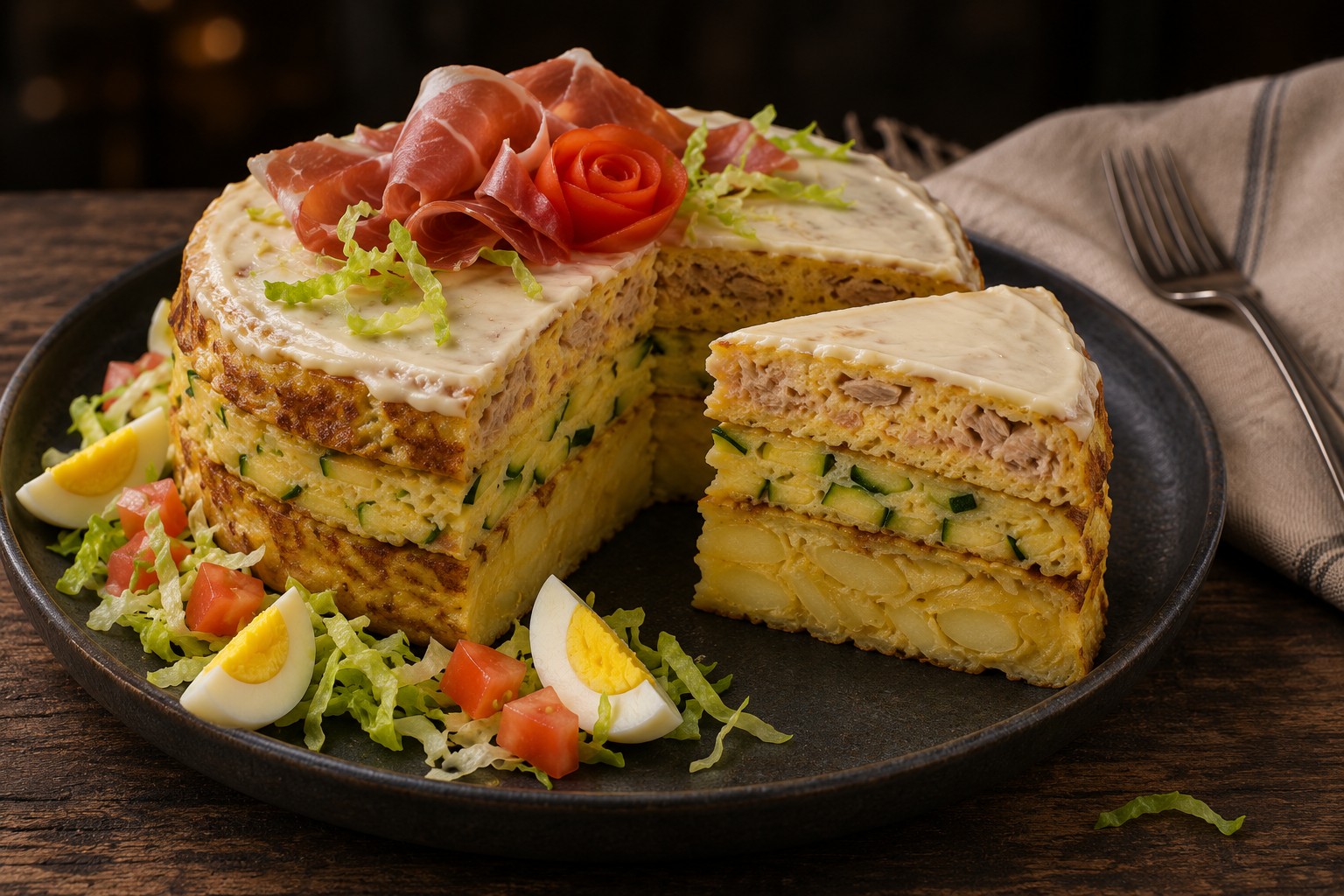
minutesThree homemade omelettes—potato and onion, courgette, and tuna—are stacked with a little butter, then finished with a thin coating of mayonnaise, serrano ham and hard-boiled egg. Bernie Torras’s savoury cake serves six, with fully set layers that slice neatly.
Mantén encendida la pantalla de tu dispositivo mientras cocinas
Ingredients
400 g peeled potatoes
400 g trimmed courgette, skin on
250 g tuna canned in oil, drained weight
10 eggs for the omelettes: 4 for potato, 3 for courgette and 3 for tuna
2 additional eggs to hard-boil for garnish
1 large onion, about 200 g peeled
30 g serrano ham shavings
80 g commercial mayonnaise made with pasteurised egg
1 tomato, about 150 g, for garnish and serving
60 g clean, thoroughly dried lettuce
60 ml olive oil: 30 ml for potato, 20 ml for courgette and 10 ml for tuna
5 g unsalted butter for the two joins between omelettes
2 g salt at most, adjusted to taste
a pinch of black pepper
Method
- Peel the potatoes and slice about 2 mm thick. Thinly slice the onion and dice the courgette small. Drain the tuna thoroughly. Put the two garnish eggs in water, bring to a gentle boil and cook for 10–11 minutes from boiling; cool in cold water, peel and refrigerate. Divide the other ten eggs into groups of 4, 3 and 3.
- Heat 30 ml oil in a non-stick frying pan. Add potato and onion, season with some of the salt and cook covered over medium-low heat for about 18–22 minutes, stirring carefully, until the potato is completely tender. Uncover near the end so no free water remains. Use the measured oil without adding a deep-frying bath.
- Meanwhile, heat 20 ml oil in another pan and cook the courgette for about 8–12 minutes. It should soften and lose excess water without becoming too brown. Season lightly. Keep potato and courgette separate and let their strongest heat subside before mixing with the eggs.
- Beat four eggs, mix with the potato and onion, and make the first omelette in a non-stick pan about 20 cm across, using the oil already coating the vegetables. Cook over medium-low heat for about 5–6 minutes on one side and 4–5 on the other, or until the centre reaches 75 °C. Turn using a plate, then transfer the cooked omelette to a different, clean plate.
- Beat three eggs, mix with the courgette and cook the second omelette in the same 20 cm pan: about 3–4 minutes on one side and 2–3 on the other, adjusting until fully set and 75 °C in the centre. Transfer to a clean plate. Keep the same diameter so the stack is stable.
- Beat the remaining three eggs, add the drained tuna and a pinch of pepper. Heat the reserved 10 ml oil and cook the third omelette in the same pan for about 3 minutes on one side and 2–3 on the other, or until 75 °C in the centre. Taste before adding extra salt: tuna and ham already contribute salt.
- While the omelettes are still warm, put potato on the bottom, spread 2.5 g butter in a thin film, add courgette, spread the remaining 2.5 g and finish with tuna. Let the initial heat subside and refrigerate promptly to finish cooling. Allow at least 30 minutes for this stage, longer if needed; never put mayonnaise on the hot cake or leave it out of the fridge for more than two hours.
- Once the cake is cool, spread the 80 g mayonnaise thinly over the top and a little around the sides. Finely shred the lettuce and cut the hard-boiled eggs into wedges. Peel the tomato in a strip and roll into a rose if reproducing the original garnish; dice the flesh to serve alongside. Decorate with ham, lettuce, tomato and hard-boiled egg.
- Cut into six portions with a clean knife, wiping between cuts to show the three layers. Serve cool with the garnishes. If not serving immediately, cover and keep at 4 °C or below; we recommend eating within 24 hours.
Notes
- The scan specifies six people and ten omelette eggs, divided 4 + 3 + 3, plus two hard-boiled garnish eggs: twelve eggs in total. This full formula is retained; the marginal note ‘2 potatoes = 3 eggs’ does not replace the printed quantities.
- The handwritten instruction to add a little butter between the omelettes is applied. The 5 g butter, 60 ml oil, 80 g mayonnaise, 30 g ham, onion and garnish weights and maximum 2 g salt specify amounts left open in the original. Tuna is weighed after draining.
- Estimated time: 25 minutes preparation, 45 minutes cooking with vegetables cooked in parallel, and at least 30 minutes cooling, totalling 1 hour 40 minutes. Cooling may take longer depending on thickness and fridge. Timings have not been measured in a cooking trial.
- Fully set all three omelettes, check 75 °C at the centre and use a clean plate after turning. Choose commercial mayonnaise made with pasteurised egg for the cold finish. Keep the cake refrigerated; it is not suitable for sitting on a room-temperature buffet for hours.
- Estimated nutrition per sixth, including mayonnaise and garnishes: USDA and NOEL serrano ham as references. Each egg is estimated at 50 g edible weight; all oil, butter and 2 g added salt are counted. Peeled potato is approximated with USDA raw potato including skin, which may affect fibre. Total carbohydrate includes fibre. Cooked serving weight has not been measured.
- Allergens: egg, fish and milk from butter. Mayonnaise may contain mustard depending on brand; check its ingredients and those of ham and tuna. Drinks and other menu dishes are excluded from nutrition.
Equipment
- Two non-stick frying pans, one about 20 cm for all three omelettes
- Small saucepan for hard-boiled eggs
- Three bowls, fork or whisk, and spatula
- Turning plate and separate clean serving plates
- Scales, measuring jug, knife, board and food thermometer
Estimated nutrition per serving
- Calories: 500kcal
- Fat: 33.8g
- Saturated Fat: 7.3g
- Sodium: 651mg
- Carbohydrates: 19.0g
- Fiber: 3.1g
- Sugar: 5.0g
- Protein: 29.5g
Have you made this recipe? I want to see it!
Tag @pucheromix on Instagram with the hashtag #mipuchero