Servings
6
servingsPreparation (approx.)
20
minutesCooking (approx.)
30
minutesCalories (approx.)
340
kcal/servingTotal time (approx.)
50
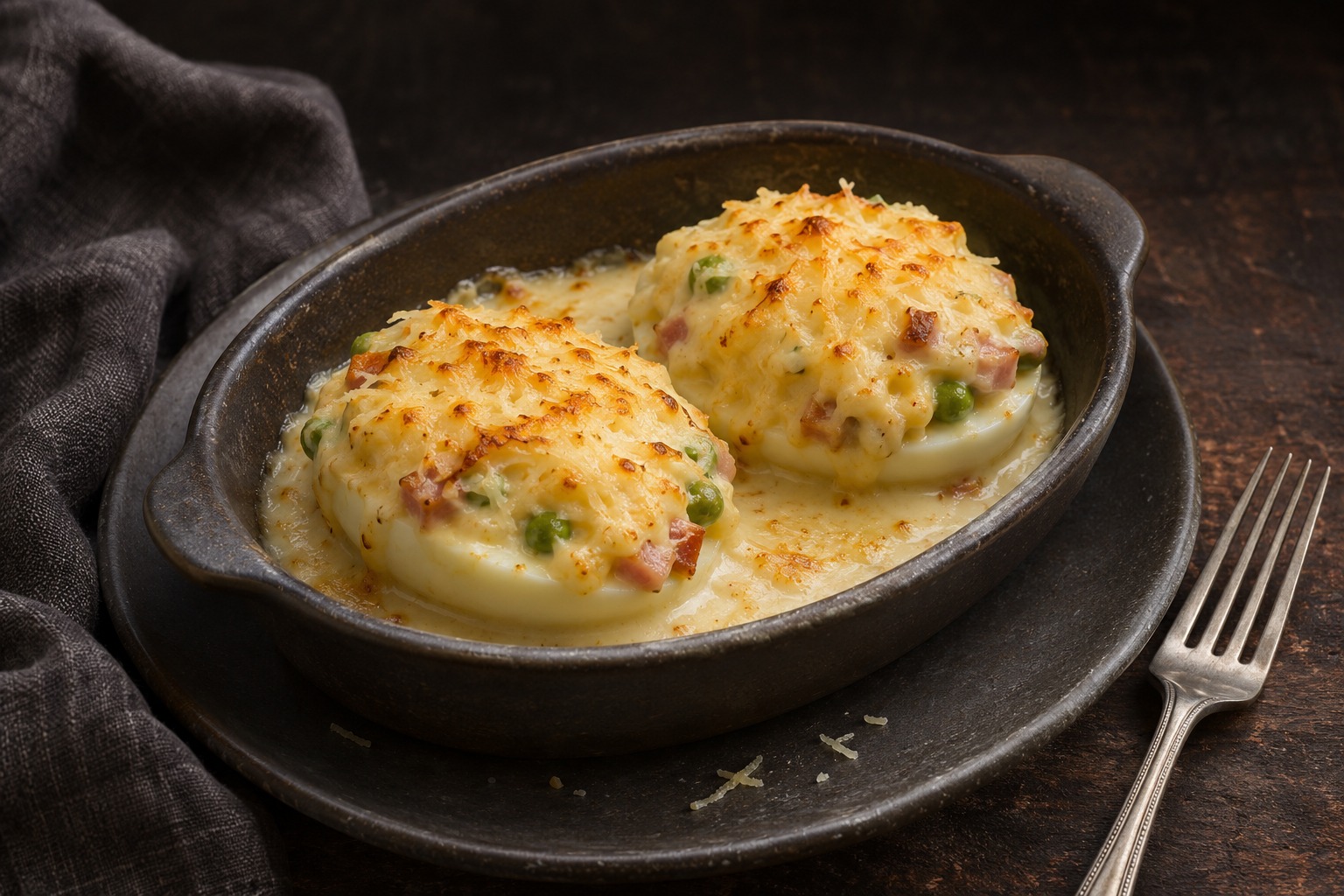
minutesHard-boiled eggs filled with their mashed yolks, smoked bacon and peas, topped with a light béchamel and golden melted cheese. From Bernie Torras's recipe collection: six starter portions, with two egg halves per person.
Modo cocción
Mantén encendida la pantalla de tu dispositivo mientras cocinas
Ingredients
6 large eggs, to hard-boil (or six already hard-boiled eggs)
100 g smoked bacon, rind removed, finely diced
200 g shelled peas, fresh or frozen
50 g unsalted butter
2 tablespoons plain wheat flour (about 20 g altogether as a working guide)
500 ml whole milk
50 g grated melting cheese, such as Emmental
5 g olive oil, suggested quantity
Salt and black pepper to taste
Method
- If starting with raw eggs, put them in a single layer in a saucepan and cover with cold water by about 2–3 cm. Bring to the boil, remove from the heat, cover and leave for about 12 minutes for large eggs. Cool immediately in cold water. Both whites and yolks should be set.
- While the eggs cook, cook the peas in boiling water until tender: around 3–5 minutes for frozen peas and a little longer for fresh peas, depending on size. Cool briefly and drain well. Follow the pack instructions if they specify a different cooking time.
- Brown the bacon in a saucepan with the 5 g of oil over medium heat for about 5–7 minutes. Remove and drain it. Pour off excess fat from the pan, following the handwritten note, and remove any burnt residue.
- In the same saucepan, melt the butter over low heat. Stir in the flour and cook for about 2 minutes without browning. Gradually whisk in the milk to prevent lumps.
- Simmer the sauce gently for about 8–10 minutes, stirring, until you have a light béchamel that coats a spoon. Season sparingly: the bacon and cheese already contain salt. Remove from the heat.
- Peel the eggs and halve them lengthways. Carefully remove the yolks without breaking the whites and mash them in a bowl. Mix with the bacon, well-drained peas and a few spoonfuls of béchamel, using only enough sauce to bind the filling.
- Fill the twelve egg-white halves with rounded mounds of filling. Arrange in a grill-safe baking dish or six small gratin dishes. Spoon over the remaining béchamel and distribute all 50 g of cheese on top.
- With the grill/broiler preheated, at about 220 °C if the temperature is adjustable, brown for roughly 5–8 minutes until the cheese is golden and the centre is hot. Watch the colour, as ovens vary. Serve two halves per person with their share of sauce.
Notes
- Source: F0205-2, 'Ous gratinats', serving six. The original six eggs, 100 g bacon, 200 g peas, 50 g butter, 500 ml milk, two tablespoons flour and 50 g cheese are retained.
- The handwritten tips are applied: start the eggs in cold water and remove excess rendered bacon fat. The printed method cooks the flour alone for ten minutes; here this is adjusted to about two minutes without browning, followed by 8–10 minutes of sauce cooking after adding milk.
- The two tablespoons of flour are estimated as about 20 g because spoon capacity and filling vary. The aim is a light béchamel. Whole milk and Emmental are explicit choices for the otherwise unspecified dairy products; the 5 g oil is also a working estimate.
- Allow approximately 20 minutes for preparation and 30 for cooking, 50 minutes total from raw eggs, with tasks overlapping. Already boiled eggs shorten the work. The scan gives no grill temperature or duration: 220 °C and 5–8 minutes are a guide, not a fixed rule.
- Estimated nutrition is for two halves and one sixth of the sauce, using USDA SR28: six boiled eggs with 50 g edible weight each, whole milk, Swiss-type cheese, 20 g flour and 5 g oil. All bacon fat is conservatively counted even though some is drained; brands and draining change the actual values.
- Carbohydrate includes fibre. Estimated sodium corresponds to about 0.57 g salt per serving, excluding salt added to taste. Finished cooked weight has not been measured. Drinks and other menu dishes are excluded.
- Allergens: egg, milk and wheat gluten. Check bacon and cheese labels for other ingredients or possible traces. The recipe contains meat and is not presented as vegetarian.
Equipment
- Saucepan with a lid for the eggs
- Saucepan for bacon and béchamel
- Whisk and spoon
- Bowl and colander
- Grill-safe dish or six small gratin dishes
- Oven with grill/broiler
Estimated nutrition per serving
- Calories: 340kcal
- Fat: 25.0g
- Saturated Fat: 11.3g
- Sodium: 226mg
- Carbohydrates: 12.3g
- Fiber: 2.0g
- Sugar: 6.8g
- Protein: 15.5g
Have you made this recipe? I want to see it!
Tag @pucheromix on Instagram with the hashtag #mipuchero