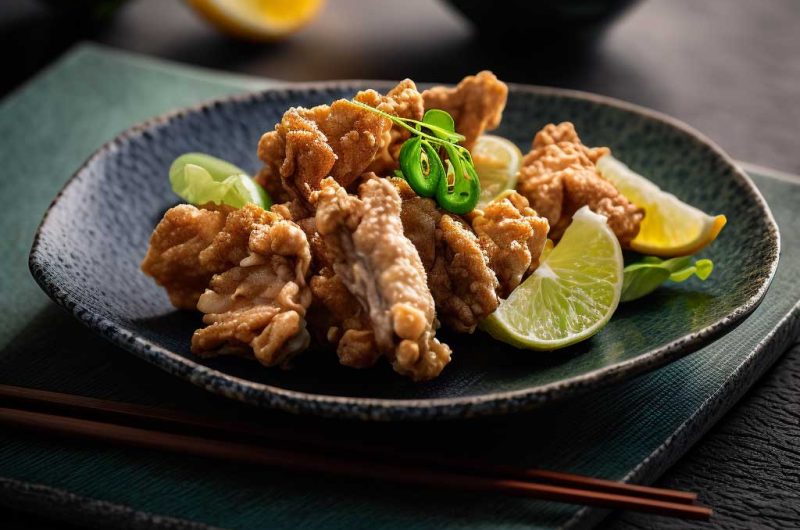
Chicken Karaage

To the point
The recipe

Chicken Karaage

0.0 from 0 votes
Course: StartersCuisine: JapaneseDifficulty: Easy
Persons

2

servings
Preparation time

1

hour 

30

minutes
Cooking time

10

minutes
Calories

295

kcal
Total

1

hour 

40

minutes

    Do you love to enjoy the authentic flavors of Japanese cuisine?

    If so, you cannot miss today's recipe: chicken karaage. This typical Japanese dish is fried chicken marinated in a delicious mixture of soy sauce, sake, garlic and ginger, then battered and fried until crispy on the outside and juicy on the inside. It is perfect as an appetizer, starter or even as a main course. Dare to prepare this recipe and surprise your guests with the authentic taste of Japanese cuisine!

    Modo cocción

    Mantén encendida la pantalla de tu dispositivo mientras cocinas

    Ingredientes

    • 2 boneless chicken thighs

    • 1 clove of garlic

    • 60 ml soy sauce

    • 60 ml of sake

    • 30 ml of mirin

    • Wheat flour

    • Cornstarch

    • Vegetable oil for frying

    • 1/4 lemon

    Pasos

    • Grate the garlic to obtain a paste.
    • Mix the soy sauce, sake, mirin and garlic and set aside.
    • Debone and cut the chicken into pieces of about 30 grams.
    • Marinate the chicken with the above mixture for about 30 minutes. The longer it is left to marinate, the saltier it will be. It is advisable not to let it marinate from one day to the next, since it remains very strong.
    • In a bowl, prepare a mixture of equal parts of flour and cornstarch, which will be used to coat the chicken.
    • Dry the chicken pieces with kitchen paper, coat with the flour and cornstarch mixture, and fry in oil at 170 °C.
    • Serve, accompanied by the lemon, and serve.

    Quizás lo necesites

    Notas

    • It can also be made with white fish: monkfish, sole, etc.. If it is made with fish, leave less time marinating, about 20 minutes approximately.

    Nutrition facts (per serving)*

    • Serving Size: 150g
    • Calories: 295kcal
    • Fat: 15g
    • Saturated Fat: 3g
    • Trans Fat: 0g
    • Cholesterol: 95mg
    • Sodium: 1180mg
    • Potassium: 250mg
    • Carbohydrates: 12g
    • Fiber: 1g
    • Sugar: 3g
    • Protein: 24g
    • Vitamin A: 50IU
    • Vitamin C: 5mg
    • Calcium: 15mg
    • Iron: 1.5mg
    Instagram

    Have you made this recipe? I want to see it!

    Tag @pucheromix on Instagram with the hashtag #mipuchero

    If you are looking for 10

    Key points of the recipe

    1. Proper marinating: Marinating the chicken for 30 minutes is crucial to infuse the flavors of soy sauce, sake, mirin and garlic. Avoid marinating it for more than one day, as it can be excessively salty.
    2. Correct batter: Prepare a mixture of equal parts of wheat flour and cornstarch to obtain a light and crunchy batter. Be sure to dry the chicken well before breading so that the mixture will adhere properly.
    3. Oil temperature: Keep the oil at a constant temperature of 170 °C to fry the chicken. This will ensure that the karaage is crispy on the outside and cooked but juicy on the inside. Avoid overloading the pan so that the oil temperature does not drop.

    Pairing with wine

    Chicken karaage is an intensely flavored and salty dish, which means that a light and fruity wine would be a good choice to balance the flavors. A dry and acidic white wine such as a Sauvignon Blanc or a Riesling can be a good choice to pair with this dish. If you prefer a red wine, a Pinot Noir could also be a good choice due to its acidity and smoothness.

    Beer pairing

    Chicken karaage has intense umami and savory flavors, making it ideal for pairing with lager or pale ale beers. A light and refreshing lager beer such as a Pilsner can work very well with this dish, as its bitterness will balance the salty flavor of the chicken. A pale ale with citrus notes and a moderate bitterness could also be a good choice for pairing with chicken karaage.

    Careful!

    Typical allergens

    Good thing it’s allergen-free!

    * In Puchero MIX we inform you about the most typical allergens in this dish. However, we recommend that you ask all diners if they have any specific food allergies. In addition, we recommend checking the labels of all individual ingredients to ensure that they do not contain traces of other allergens, as conditions may vary by producer or manufacturer.

    You may be interested in
    Other recipes with
    Other recipes that pair with
    Share this recipe
    Scroll to Top